Why South and West Walls Fail First: Altitude Paint Chalking
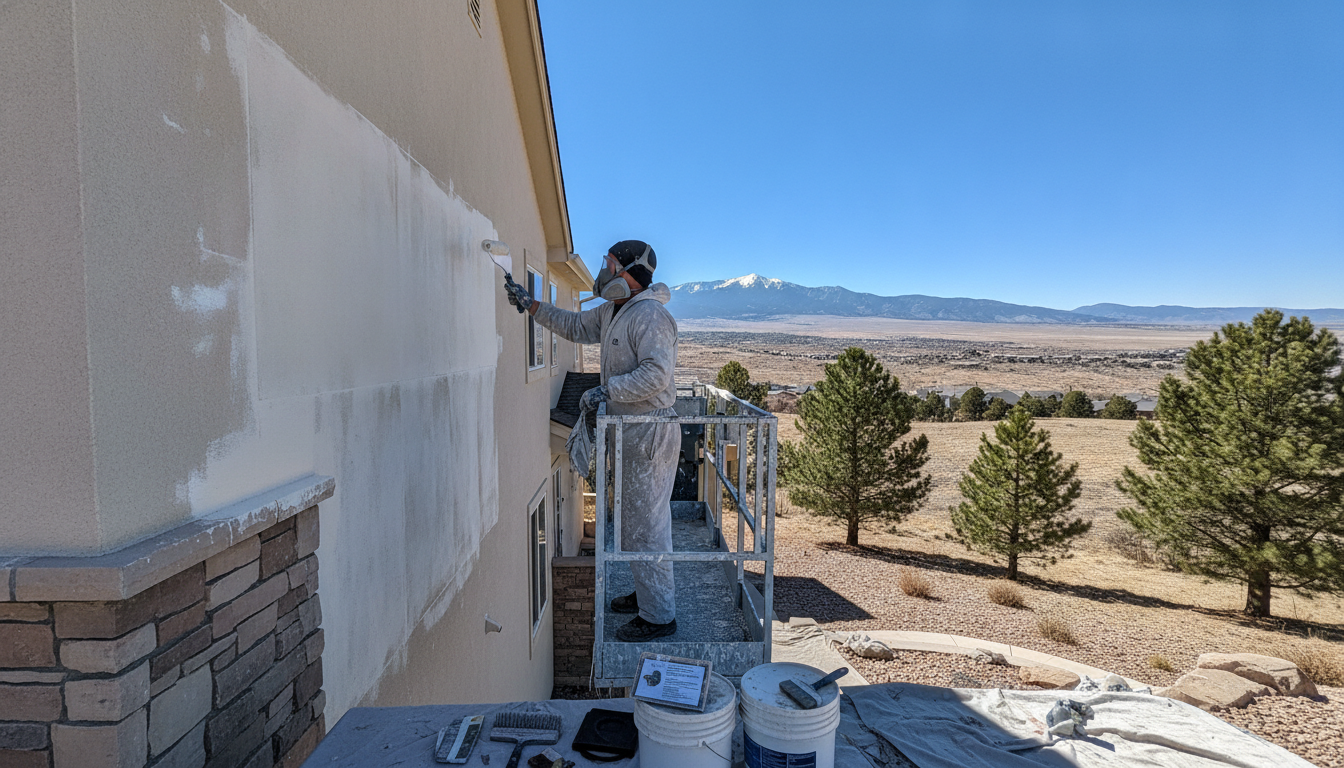
Why exterior paint chalks and fades faster on Colorado Springs south and west walls, and how to spec paint by elevation at 6,000+ feet. Free estimates.
If you walk around your house this fall and rub a hand across the south wall, then do the same on the north side, you will likely feel a difference. The south wall leaves a fine powder on your palm. The north wall does not. That is not your imagination, and it is not uneven aging. It is physics, and it is one of the most predictable things about painting a house at 6,000 feet.
Why South and West Walls Take the Damage First
Every exterior coating is exposed to UV light, but not evenly. In Colorado Springs and the surrounding Front Range, south and west elevations absorb far more direct sun over the course of a year than north and east walls, which spend much of the day in shade or catching only indirect, lower-angle light. Add in the elevation itself — the UV load above 6,000 feet is materially higher than at sea level, with less atmosphere to filter it — and the south and west sides of a house are doing years more work than the other two.
UV breaks down the resin binder in a coating over time. As the binder degrades, pigment particles at the surface lose their grip and start to release as a fine powder. That is chalking, and it is the paint's way of telling you the coating is used up. Fading is the visible half of the same process, since the same UV breakdown that causes chalking also causes color to wash out unevenly, worst on the sunniest walls.
Why Fall Is When You Notice It
By September and October, a south or west wall has just finished absorbing an entire summer of high-angle sun, long days and, in most years, very little cloud cover. Chalking that was barely noticeable in June is often obvious by fall. It is also the point where people start thinking about exterior projects for next year, so it is worth understanding what you are looking at before you call anyone out for an estimate.
Specification Should Change by Elevation, Not Just by House
Most bids treat a house as one job with one paint. That is a mismatch. A wall doing years more UV exposure than its neighbor should not necessarily get the identical coating, and it should certainly not get a cut-rate one. On exterior siding and trim, 100% acrylic coatings hold up because they stay flexible through the 30-to-40-degree daily temperature swing that is normal here — a brittle, lower-grade coating cracks right at the joints that are supposed to be keeping water out. Cheaper vinyl-acrylic blends chalk and fade noticeably sooner on a south or west exposure, which is exactly where you cannot afford a short service life.
On stucco, a masonry or elastomeric coating can bridge hairline cracking and shed water well, but it also slows how a wall dries outward. On a wall that already holds moisture, that can make things worse rather than better. Whether that trade-off makes sense is a judgment made on site, wall by wall, not a default applied to the whole house.
What This Means for Your Repaint Timeline
The general rule of thumb for this area is a repaint cycle of roughly 5 to 10 years, but that range is wide because exposure and substrate matter more than age. A north-facing wall on a shaded lot might comfortably hit the far end of that range. A bare south or west wall on an open lot might be chalking by year five or six. The test is the wall, not the calendar.
This is also why the exterior order matters before anything gets a color: washing the house down, repairing anything that has actually failed, and sealing the openings around trim and penetrations. A fresh coat over chalked, unwashed siding will not bond properly no matter how good the paint is.
Whether you are in central Colorado Springs, the Tri-Lakes area around Monument, Black Forest, Falcon, Fountain, up in Woodland Park where the season runs shorter, or down in Pueblo where it runs longer, the same elevation logic applies: the sunniest walls need the most durable spec, and that decision should be made surface by surface, not house by house.
Happy Painting has been specifying coatings by exposure and substrate for exterior painting, stucco repair, siding repair and full HOA and apartment community repaints across the Colorado Springs area for 13 years, with Josh Welp bringing over 25 years in the trade, including time on the supply side specifying coatings for other contractors. Estimates are free and done on site, with no obligation.
Frequently Asked Questions
Why does my south wall look worse than the rest of the house?
It is absorbing far more direct sun over the year than the north or east walls, and at 6,000-plus feet that UV load is higher than at sea level. That accelerates the breakdown of the coating's binder, which shows up as chalking and faster color fade.
Should I use the same paint on every side of my house?
Not necessarily. South and west walls do more work than north and east, so a durable 100% acrylic coating on the sun-exposed sides matters more than it does on shaded elevations. A contractor should be looking at exposure per wall, not just picking one product for the whole house.
Is chalking a sign I need to repaint right away?
It means the coating is nearing the end of its service life and will not hold a new coat until the chalk is washed off first. It is not an emergency, but it is worth having someone look at the whole house, since other walls may still have years left.
Ready for a Free Estimate?
If your south or west wall is chalking or fading this fall, Josh will come out, look at each elevation, and tell you honestly what it needs. Call (719) 373-5550 or reach out online for a free, no-obligation estimate.